San Francisco Historic District
) 2103-2107 Bush Street
2103-2107 Bush Street
18 May 2010
(Click Photo to Zoom)
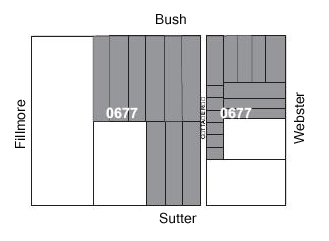
Map Courtesy of San Francisco
Planning Department
Bounded by Bush, Webster, Fillmore, and Sutter Streets
Designated September 1991
Bush Street–Cottage Row Historic District is a remarkably intact group of architecturally consistent Italianate and Stick residential buildings constructed between 1870 and about 1885. It demonstrates several different modes of speculative housing during those years, from the mass builder The Real Estate Associates, which developed whole square blocks, through investors John H. Smyth and Charles L. Taylor, who built houses to hold and rent out for income, to the single homeowner. Taylor himself chose the name Cottage Row, which was listed among San Francisco's streets as early as the 1886 Directory.
Since they were built, the houses have been residences with some alterations. The walkway of Cottage row continued until 1944 as part of a single piece of private property. The Cottage Row houses were separated into individual ownerships gradually from 1956–1967, and only on the last date was the walkway singled out as an individual holding separate from any house.
In the 1930s Cottage Row was popularly called Japan Street, because the entire district was inhabited by Japanese-Americans until their internment during World War II. In the tiny rear yards they grew vegetables, which they offered for public sale at an informal weekly open market held every Saturday along the Row.
Adapted from San Francisco Planning Code: Article 10, Appendix K.
