San Francisco Historic District
)
25 May 2008
(Click Photo to Zoom)
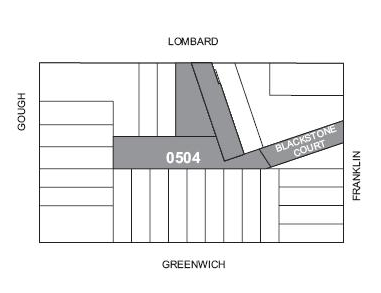 Map courtesy of San Francisco Planning Department
Bounded by Lombard, Franklin, Gough, and Greenwich
Designated November 1987
The entire district is gated, private property, closed to the casual visitor.

The significance of Blackstone Court is more historical than architectural, though enough physical evidence of past history remains to create a sense of the former place and time in this unusual mid-block enclave of five structures on a blind alley.
Blackstone Court was built on an early trail that ran from town toward the Presidio around the north end of Washerwoman's Lagoon which was drained and filled long ago.
The building at 9-11 Blackstone Court appears to date from the 1850's because of its Gothic Revival veranda and its interior plan and finish. The building, which may have been moved here, is first documented on this site in 1893. Before 1899 it was raised a story by the Favilla family from North Beach, very early Italian-American residents in what became the Marina District.
Abraham House, 30 Blackstone Court, was constructed in 1885 by Charles Abraham, and enlarged by him in 1905. Abraham was the founder of Western Nursery, which operated on most of this block from 1885 to 1947. Western Nursery was the last agricultural enterprise in the Cow Hollow/Marina District.
An Australian peppermint tree and a Monterey Cypress appear to date from the nursery.
Adapted from San Francisco Planning Code: Article 10, Appendix H.