San Francisco Historic District: South End
) 8 February 2009
8 February 2009
100 Block of King Street
The large brick building with the fire escape is the Townsend Building. The rear of the building is on King Street. The front of the building, pictured below, is on Townsend Street.
) 4 November 2023
4 November 2023
California Warehouse at 88 Townsend Street was built in 1882.
This building was once a one-story warehouse. One-story warehouses were common in the 19th century but rare in the early 20th century as the cost of land increased.
In the early 21st century, the California Warehouse was gutted and replaced by more than one hundred residential units. Two exterior walls of the warehouse were incorporated into the new building.
"This isn't preservation, it's mockery. And it happens too often." John King, San Francisco Chronicle, 22 February 2005.
 4 November 2023
John Hooper's South End Grain Warehouse at 64-72 Townsend Street was built in 1874.
) 4 November 2023
4 November 2023
This six-story warehouse at 123 Townsend Street extends to King Street with the alternate address of 118 King Street. It was built in 1903 as a Haslett Warehouse for the Southern Pacific Company.
After 1906, almost all new warehouses were at least three stories in height, and several such as the Townsend Building and California Warehouse, reached six stories.
) 4 November 2023
4 November 2023
California Warehouse at 601 Second Street, built in 1909
Charles Norton Felton who was a senator, a congressman and an early developer of oil in California, is associated with this warehouse and the warehouse next door at 275 Brannan Street.
) 4 November 2023
4 November 2023
Second Street Elevation of the California Warehouse
This well preserved post and beam warehouse retains double-hung windows with wooden sashes, a slanted rail-spur entrance and metal awnings.
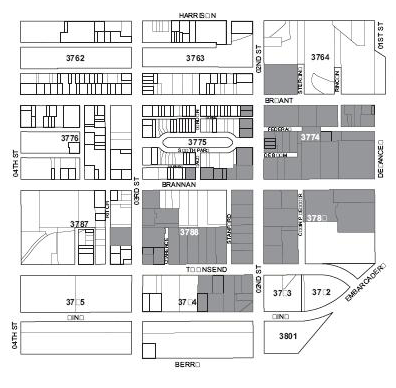
Map Courtesy of San Francisco
Planning Department
Bounded by Stillman, First, Ritch, and King Streets
Period of significance: 1867-1935
Designated September 1991
For decades after the 1849 Gold Rush, San Francisco was the principal seaport on the west coast. The South End District contains an extraordinary concentration of buildings from almost every period of San Francisco's maritime history. Most of the buildings were constructed between 1906 and 1929, a period during which trade along the waterfront increased dramatically.
The building of Long Bridge in 1865 encouraged industrial development in this part of San Francisco. The Second Street cut of 1869, through fashionable Rincon Hill, facilitated access from downtown. The year 1869 also marked the completion of the transcontinental railroad.
The 1906 Earthquake and Fire and the opening of the Panama Canal in 1914 were further catalysts to warehouse construction here, as were the seawall and the Belt Line Railway.
Four surviving buildings were built in the 19th century including Hooper's Warehouse and California Warehouse, pictured on this page, and the California Electric Building. All three of these buildings survived for a century before being desecrated by developers in the early 21st century.
Four surviving buildings were built in the first six years of the 20th century preceding the 1906 Earthquake and Fire, including the Townsend Building, pictured on this page.
After 1906, almost all new warehouses were at least three stories in height. Several warehouses on Second and Townsend Streets reached six stories.
The invention of the forklift in the 1930s eliminated the advantages of multi-story warehouses. Since 1945, almost all warehouses built in the United States have been one story in height.
Adapted from San Francisco Planning Code: Article 10, Appendix I.